
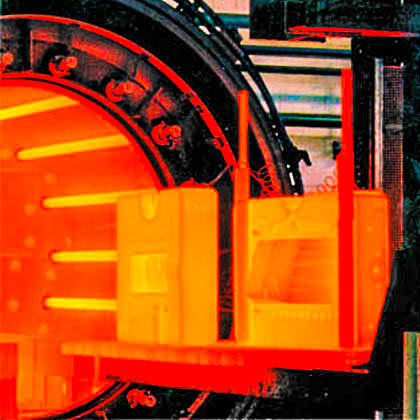
When evaluating vacuum hardening, the advantage is not simply that the treatment takes place in a low-pressure, controlled atmosphere. Its real value emerges when surface condition, process control and final component performance need to be considered together.
For parts used in demanding engineering applications, achieving a target hardness value is only one part of the requirement. Surface integrity, control of oxidation and decarburisation, dimensional stability, compatibility with downstream operations and process repeatability can be equally important.
Vacuum hardening can therefore be particularly relevant when material grade, geometry and technical specifications call for a tightly controlled thermal process with minimal interaction between the steel and the surrounding atmosphere.
T.T.N. S.p.A. performs vacuum heat treatment on industrial components within a production environment that integrates heat treatment expertise with machining and surface engineering capabilities.
What Changes When Heat Treatment Is Performed Under Vacuum
During conventional heat treatment, steel may interact with the atmosphere inside the furnace. At elevated temperatures, this can lead to surface reactions that alter the condition of the component.
Under vacuum, the process takes place in a highly controlled environment with a very low concentration of reactive gases. This helps limit oxidation and decarburisation, preserving the surface condition of the steel more effectively.
The benefit is not purely cosmetic. A cleaner, less altered surface can reduce the need for corrective operations and may be particularly valuable where the part must retain defined surface characteristics before precision machining or subsequent surface treatments.
Vacuum processing should therefore be viewed as part of a broader manufacturing strategy in which material, geometry, surface condition and final performance requirements are considered together.
Why Oxidation and Decarburisation Matter
Oxidation changes the surface through the formation of oxide layers, while decarburisation reduces the carbon content in the outer region of the steel.
Both can become relevant when surface properties contribute directly to component performance.
Decarburisation, for example, can affect the hardness that can be achieved near the surface. Oxidation may alter surface condition and create the need for additional finishing operations.
Processing under vacuum helps minimise the interaction between the material and the furnace atmosphere, supporting better surface preservation and more controlled treatment conditions.
When Surface Condition Becomes a Process Requirement
Not every component requires the same degree of surface protection. In some applications, subsequent machining can remove altered surface layers. In others, surface condition must be preserved as part of the heat treatment strategy itself.
This becomes particularly relevant where the part has tight geometric requirements, functional surfaces that are already defined, or downstream operations that depend on a controlled surface condition.
Vacuum hardening can therefore be particularly suitable for mechanical components, tooling, dies and parts manufactured from special steels where final quality depends not only on bulk properties, but also on limiting oxidation and surface alteration.
The choice must still be application-driven. Vacuum processing is not automatically the best option in every case. It offers specific advantages where material behaviour, geometry and manufacturing requirements justify its use.
Material Hardenability: Vacuum Hardening Is Not Suitable for Every Steel in the Same Way
Treating vacuum hardening as a universal solution for any steel grade would be an oversimplification.
The result depends first of all on the hardenability of the material, meaning its ability to develop the required microstructure and mechanical properties under the available cooling conditions.
Steel grade, section thickness and heat extraction rate all influence the final outcome. Before defining the cycle, it is therefore important to consider:
- steel composition and metallurgical condition;
- component thickness and geometry;
- required final properties;
- available cooling conditions;
- dimensional tolerances and downstream operations.
Vacuum alone does not determine the quality of the result. What matters is the alignment between material, thermal cycle and application requirements.
Vacuum Hardening and Dimensional Stability: What to Expect
Dimensional stability is often associated with vacuum hardening, but it needs to be discussed carefully.
A controlled atmosphere does not mean a component will not distort. Heating, metallurgical transformations, section changes and residual stresses still influence the way the material behaves during the cycle.
Vacuum hardening provides highly controlled processing conditions, but dimensional response still depends on geometry, steel grade and the overall manufacturing route.
It is therefore more accurate to talk about distortion management and control, rather than distortion elimination. Where tight tolerances are required, the heat treatment cycle should be planned together with dimensional inspection and any necessary downstream machining.
The Role of Downstream Operations
Heat treatment should rarely be considered in isolation. Final component quality also depends on the operations that come before and after the thermal cycle.
With vacuum hardening, preserving surface condition can be an advantage when the part is subsequently ground, finished or prepared for surface coatings.
The production sequence still needs to be defined carefully. Each downstream operation can interact with the properties already achieved and with the final dimensional requirements.
For demanding components, it therefore makes sense to consider heat treatment, machining, inspection and surface engineering as part of the same manufacturing route.
The TTN Group structure brings together different capabilities, from vacuum heat treatment to machining and surface coating processes.
Process Control and Verification of the Final Result
As with any heat treatment, vacuum hardening must be verified against the technical requirements of the component.
Hardness, microstructural characteristics, dimensional requirements and compliance with the relevant specification should be assessed according to the application and inspection plan.
T.T.N. S.p.A. supports production with laboratory activities, material testing and quality control, using process and inspection data to verify the properties achieved and support cycle development.
This makes it possible to evaluate the treatment through measurable results rather than relying on a single parameter.
Frequently Asked Questions
Does vacuum hardening completely eliminate distortion?
No. Vacuum processing provides highly controlled conditions, but distortion also depends on material grade, geometry, section changes, residual stresses and cooling conditions. It can often be managed and reduced, but not necessarily eliminated.
Which steels can be vacuum hardened?
This depends on the hardenability of the steel and the characteristics of the part. Different steel grades respond differently to the available cooling conditions, so material composition, section thickness and required properties must all be considered.
What is the difference between vacuum hardening and hardening in a conventional atmosphere?
One of the main differences is the treatment environment. Under vacuum, the very low concentration of reactive gases helps limit oxidation and decarburisation, supporting better preservation of the component surface.
Why is vacuum hardening relevant for components with tight dimensional requirements?
Because it combines a high level of process control with improved surface protection, which can be important where the part has tight tolerances, functional surfaces or downstream operations that depend on consistent surface condition.
The Advantage Depends on the Application, Not the Process Name
Vacuum hardening should not be viewed as universally superior, but as a highly effective option when material, geometry and surface requirements call for a tightly controlled treatment environment.
Its value becomes particularly clear when the required metallurgical properties must be achieved while also limiting oxidation, decarburisation and unwanted surface alteration.
The decision should therefore start with the component and its intended use, considering steel grade, geometry, cooling conditions, tolerances and downstream manufacturing requirements.
T.T.N. S.p.A. performs industrial vacuum heat treatment and develops cycles aligned with component specifications, supported by laboratory expertise, quality control and integration with other manufacturing stages.
Contact us to discuss the most suitable vacuum heat treatment for your component.