
Trattamenti
Termici Nervianesi
Heat treatment, coating and integrated machining
for high-performance metal components
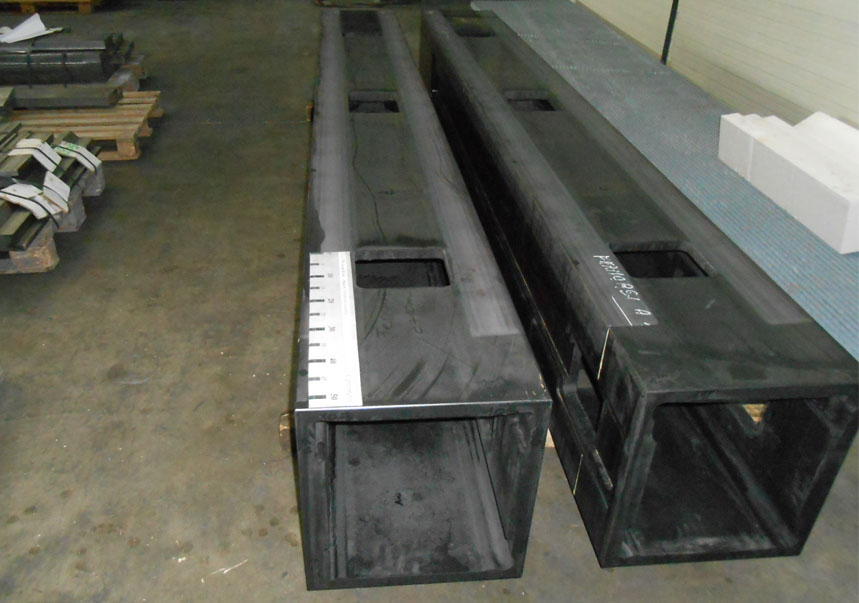
Induction Hardening of High-Wear, High-Stress Components
Induction hardening is a localized surface heat treatment used to increase hardness in specific areas of a component while preserving a tough, impact-resistant core. The process selectively hardens surfaces exposed to wear, friction, and high mechanical loads, avoiding unnecessary treatment of the entire workpiece.
At T.T.N. S.p.A., induction hardening is performed on components of various sizes and geometries, including machine beds and guideways for boring machines, lathes, and milling machines. Each treatment cycle is engineered according to the steel grade, component geometry, required case depth, and actual service conditions.
The use of high-, medium-, and low-frequency induction generators, combined with CNC-controlled equipment and in-house designed induction coils, ensures accurate heating and uniform hardened case profiles. The process can be complemented by tempering, stress relieving, distortion inspection, and straightening operations, delivering components that fully comply with the required technical specifications.
How induction hardening works
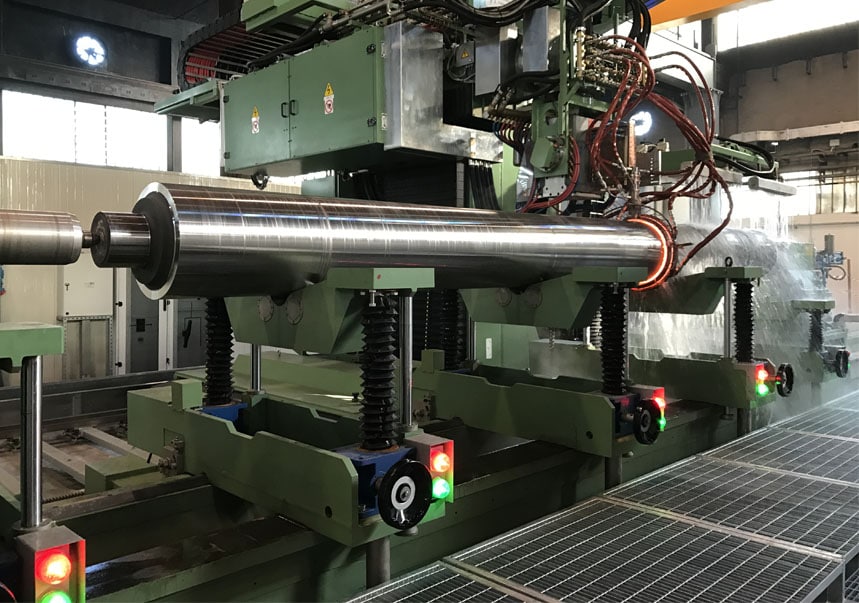
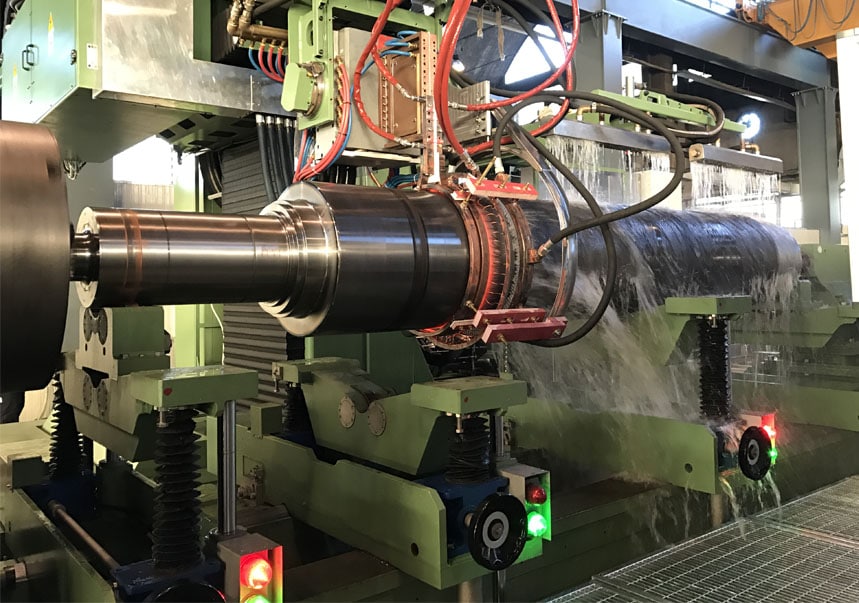
Induction hardening uses an electromagnetic field to generate heat directly within the areas to be hardened. Heating is rapid and highly localized, allowing only the required surface regions to be treated while leaving the rest of the component unaffected.
The component is then quenched using the cooling medium best suited to the steel grade and the required performance characteristics. This metallurgical transformation increases surface hardness while preserving the mechanical properties of the core, ensuring the toughness and strength needed to withstand service loads.
By precisely controlling frequency, power output, heating time, and quenching parameters, the process can be tailored to flat surfaces, cylindrical components, and complex geometries, delivering consistent and repeatable hardening results.
Process control and case depth
The effectiveness of induction hardening depends on precise control of the process parameters. T.T.N. S.p.A. is equipped with:
- Induction generators rated up to 1,000 kW, operating at high, medium, and variable low frequencies;
- State-of-the-art CNC-controlled induction hardening systems;
- In-house designed and manufactured induction coils developed by qualified specialists;
- The capability to achieve case depths of up to approximately 30 mm, depending on the material grade and application requirements.
The custom design of each induction coil allows the electromagnetic field to be accurately matched to the component geometry, ensuring uniform hardening even in the most complex areas while maintaining a high level of process repeatability.
T.T.N.
Components and applications
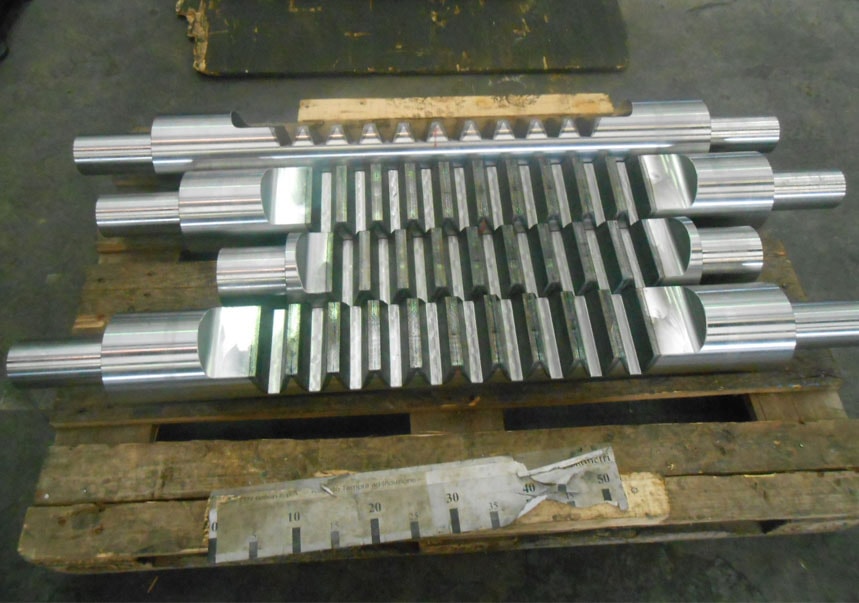
Typical applications include shafts, rollers, pistons, power transmission components, and dies, as well as machine tool beds, columns, rams, plates, and guideways.
Because only the functional surfaces are hardened, the process is particularly well suited for large or geometrically complex components, where through-hardening of the entire workpiece would be unnecessary and inefficient.
Equipment and production capabilities
The available equipment enables the treatment of components ranging from compact parts to large-scale industrial assemblies.
The main production capabilities include:
-
Shafts, rollers, and pistons up to Ø 1,200 mm and lengths of up to 16,000 mm;
-
Machine beds, columns, rams, plates, and guideways up to 3,000 × 2,000 × 12,000 mm;
-
Power transmission components up to Ø 4,000 × 750 mm;
-
Dies up to 3,000 × 3,000 mm.
Quenching is performed using water, Aquaquench, or air, with the cooling medium selected according to the material grade and the performance requirements of the heat treatment cycle.
A fully integrated process within the production cycle
Induction hardening is one stage of a broader manufacturing process, in which each operation contributes to the final performance of the component. By integrating heat treatment with tempering, stress relieving, straightening where required, and final inspection, T.T.N. S.p.A. manages every stage of the process, ensuring consistent quality, repeatability, and full compliance with customer specifications.
When required by the production cycle, induction hardening can be combined with T.T.N. S.p.A.’s additional machining operations and technical services, providing comprehensive support throughout the entire manufacturing process.
Tempering, stress relieving, and straightening
Following induction hardening, the process may continue with complementary treatments designed to stabilize the mechanical properties and verify the dimensional accuracy of the component.
Subsequent operations may include:
- Tempering and/or stress relieving;
- Verification of straightness and flatness;
- Straightening, where required, using presses with capacities of up to 1,000 tonnes;
- Final inspection and certification performed by qualified personnel.
The integration of these operations enables T.T.N. S.p.A. to manage the component throughout the entire production cycle, ensuring that its mechanical and dimensional characteristics fully comply with the required technical specifications.
Markets and applications
Induction hardening is widely used in industries where components must provide outstanding wear resistance, reliability, and long-term performance under heavy loads or demanding operating conditions. Typical applications include the aerospace and defense, automotive, industrial manufacturing, sheet metal forming and blanking, energy and oil & gas, food processing, general engineering, and earthmoving sectors. The process is also extensively employed in the marine, die casting, hot forging, and plastics molding industries, where the durability of functional surfaces has a direct impact on production efficiency.
Each heat treatment cycle is engineered according to the material grade, component geometry, and required performance characteristics, ensuring reliable, consistent, and repeatable results even in the most demanding applications.