
When a steel component has to withstand wear, friction and repeated loading, increasing hardness may appear to be the most obvious solution. In practice, however, higher hardness does not automatically translate into better performance. In many engineering applications, the surface and the core need to deliver different mechanical properties.
The surface may require high resistance to wear and contact stresses, while the core must retain sufficient toughness to absorb loads, impacts and cyclic stresses without becoming excessively brittle. The engineering challenge is therefore not to maximise a single property, but to achieve the right balance across the component.
For this reason, heat treatment selection should start with how the part will perform in service. Steel grade, geometry, loading conditions, functional surfaces and required hardening depth all influence the most appropriate process and the final property profile.
Why Surface Hardness and Core Toughness Must Be Considered Together
Hardness and toughness describe different aspects of material behaviour. Hardness indicates a material’s resistance to localised plastic deformation and, in many applications, is closely associated with wear resistance. Toughness, by contrast, relates to the ability to absorb energy before fracture.
A very hard part may therefore perform effectively in areas exposed to contact and sliding, but hardness alone does not define overall reliability. Where a component is also subjected to impact, bending or dynamic loading, the behaviour of the entire section must be considered.
This is particularly relevant for gears, shafts and other power transmission components, where functional surfaces need to resist wear while the core contributes to carrying mechanical loads.
Depending on the application, it may be appropriate to modify the properties across a substantial part of the section. In other cases, the better solution is to concentrate hardening where the operating conditions actually demand it.
When Surface Hardening Is the Right Approach
Not every area of a component experiences the same type of stress. Critical loading may be concentrated on contact areas, sliding surfaces or specific zones exposed to friction and cyclic loading.
In these situations, surface hardening makes it possible to engineer the properties of the outer layer without altering the whole section in the same way. The aim is to create a surface capable of resisting the dominant wear and contact mechanisms while maintaining core properties suited to the structural role of the part.
This approach is relevant to gears, transmission shafts, guideways, rolls, pistons, dies and other mechanical components where surface and core perform different functions.
The decision should always be based on the actual duty cycle. Contact pressure, motion type, load distribution, operating cycles and material characteristics all help determine whether surface hardening is appropriate and what level of performance is required.
Hardening Depth Matters as Much as Surface Hardness
A surface hardness value alone does not fully describe the performance of a treated component. Another critical parameter is the depth of the hardened or modified layer, which must match the way stresses are distributed in service.
If the effective hardened depth is too limited for the application, the treated surface may not provide the required support under load. Conversely, a deeper hardened zone is not automatically better if the application does not require it.
The objective is therefore not to maximise depth, but to achieve a property profile that matches the component design and service conditions.
With induction hardening, for example, frequency, power, heating time, inductor design and material response influence the depth and distribution of the hardened zone. T.T.N. S.p.A. operates high-, medium- and low-frequency systems with adjustable power up to 1,000 kW, allowing hardening depths of up to approximately 30 mm for suitable applications.
Carburizing and nitriding work differently. In these processes, the modified case develops through diffusion of elements into the surface, so the underlying mechanism, process controls and achievable case characteristics differ significantly from induction hardening.
Carburizing, Nitriding and Induction Hardening: Different Routes to Surface Performance
When the target is improved surface performance, several technologies are available, but carburizing, nitriding and induction hardening are not interchangeable processes.
Carburizing enriches the surface layer with carbon. Following the subsequent stages of the heat treatment cycle, it can produce a hard, wear-resistant case supported by a tougher core, making it suitable for components exposed to contact stresses and dynamic loading.
Nitriding introduces nitrogen into the surface at comparatively low processing temperatures. Depending on steel grade and application, it can provide high surface hardness, wear resistance and good dimensional stability.
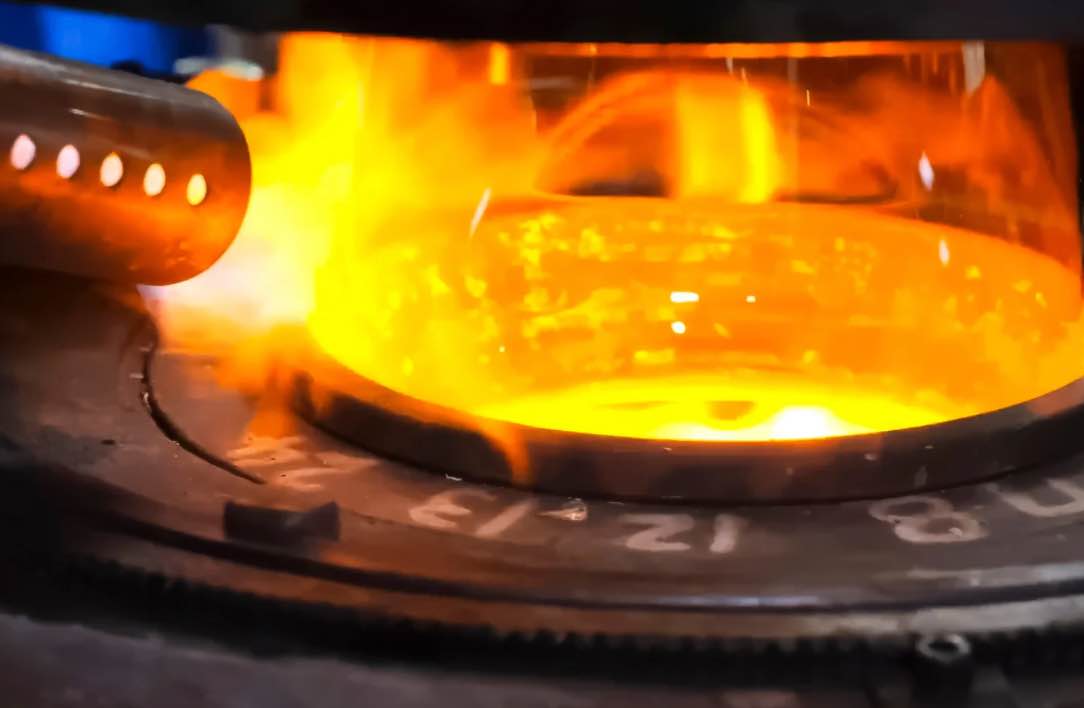
Induction hardening follows a different principle. Localised electromagnetic heating allows selected areas of the component to be treated, followed by cooling to achieve the required metallurgical transformation. Frequency, power and inductor geometry can be adapted to the target area and required hardening depth.
Material Selection and Service Conditions Drive the Process Choice
There is no single surface-hardening process that suits every component. The first step is to identify what problem the treatment needs to solve and what performance the part must deliver in service.
Steel grade is a fundamental constraint because chemical composition and metallurgical condition determine how the material responds to different processes. Geometry also matters: dimensions, section changes and functional areas can affect both process feasibility and the way the resulting properties are distributed.
Operating conditions must then be considered as a complete system. A part exposed mainly to sliding wear has different requirements from one subjected to impact, alternating loads or high contact pressures.
For this reason, hardness should never be treated as an isolated target. Surface hardness, effective hardening depth and core properties must work together, and they must also be compatible with the manufacturing operations carried out before and after heat treatment.
How the Result Should Be Verified
Once the process is complete, inspection should confirm that the required properties have actually been achieved. In surface-engineered components, this generally means looking beyond a single hardness value.
Depending on the treatment and applicable specification, verification may include:
- surface hardness and hardness profile;
- effective depth of the treated layer;
- metallurgical and microstructural characteristics;
- geometric and dimensional requirements where relevant.
This becomes particularly important for components used in demanding industrial applications or where treatment results must comply with customer-defined technical specifications.
T.T.N. S.p.A. supports production processes with laboratory and inspection activities including metallurgical analysis, microstructural evaluation, verification of mechanical properties and non-destructive testing. The aim is to assess the outcome of the heat treatment against measurable and documented criteria.
Frequently Asked Questions
Is a harder steel component always more wear-resistant?
Not necessarily. Higher hardness can contribute to improved wear resistance, but actual performance also depends on the wear mechanism, contact conditions, steel grade and overall component design. Hardness should therefore not be treated as the only performance indicator.
What is the difference between surface hardening and through-section heat treatment?
Through-section heat treatment modifies material properties across a substantial part, or potentially all, of the component section. Surface hardening concentrates specific properties in the outer or functional areas while preserving different characteristics in the core.
How do you choose between carburizing, nitriding and induction hardening?
The choice depends on steel grade, geometry, required hardening depth, service conditions and final performance requirements. Because the three processes rely on different mechanisms, they should be evaluated against the actual application rather than selected solely on the basis of target hardness.
Why is effective hardening depth important?
Because service stresses are not limited to the outermost surface. The treated depth must be appropriate for the way loads are transferred through the component so that the resulting property profile supports the intended application.
Engineering the Right Properties Where They Are Needed
Simply targeting maximum hardness can oversimplify a broader engineering problem. The surface and the core may have different functional roles, and the required material properties should reflect those roles.
The decision between through-section treatment, localised hardening and thermochemical treatment should therefore be driven by the application, steel grade, geometry, required depth and operating conditions.